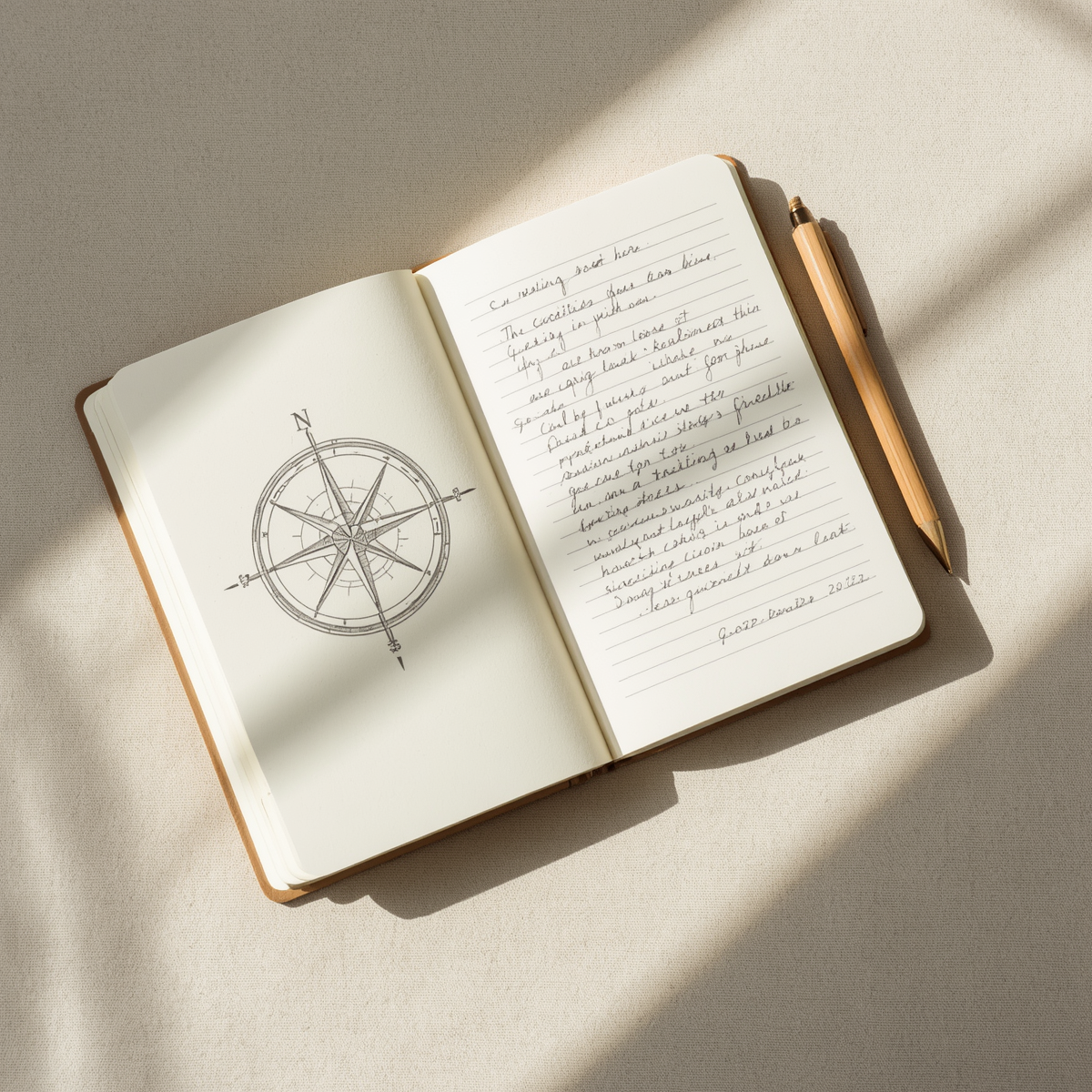
Mindful Journaling
Mindful Journaling: How to Reflect Without Overthinking
Daily prompts and habits for clearer personal and professional growth
When you’re trying to work out what comes next in your career, journaling can seem like an obvious place to start.
Write down your thoughts. Make a pros-and-cons list. Explore your options. Try to work out what you really want.
But there can be a problem.
If you’re already prone to overthinking, an empty journal page can sometimes become another place to overthink.
You may find yourself analysing the same questions from slightly different angles, searching for the “right” answer or filling pages without actually feeling any clearer about what to do next.
That doesn’t mean journaling isn’t useful.
It may simply mean you need a different way of using it.
Rather than journaling to solve everything, mindful reflective journaling can help you slow down enough to notice what is happening beneath all that thinking.
And sometimes, that is where clarity begins.
The difference between thinking and reflecting
Thinking and reflecting can look very similar.
Both involve considering your experiences, choices and possibilities. But they don’t always take you to the same place.
When we’re caught in an overthinking loop, our attention often moves repeatedly around questions such as:
What if I make the wrong decision?
Should I stay where I am?
What else could I do?
What would happen if I changed direction?
Am I being unrealistic?
What if I regret leaving?
The mind keeps searching for certainty.
Reflective practice asks something slightly different.
Instead of demanding an immediate answer, reflection creates space to become curious about what you are noticing.
For example:
What keeps drawing my attention?
What am I experiencing when I imagine staying where I am?
What feels important to me at this stage of my working life?
What might I be overlooking because I am so focused on finding an answer?
This small shift — from “I need to work this out” to “I wonder what I can notice here” — can change the quality of the reflection.
Your journal doesn't have to contain the answer
One of the most useful habits you can develop is to stop treating every journal entry as something that needs to end with a conclusion.
Sometimes its purpose is simply to help you notice.
You might notice that the same frustration appears repeatedly.
You might recognise that something you once valued about your career no longer feels as important.
You might discover that the option that looks most sensible on paper doesn't create much energy or curiosity.
Or perhaps you begin noticing that there are parts of your current work you want to preserve, even if other parts need to change.
These observations may seem small.
But when they accumulate over time, patterns begin to emerge.
And patterns can provide information that another round of analysis may not.
A simple daily reflective habit
You don't need to spend an hour journaling every morning.
In fact, if you're already busy and mentally overloaded, creating another large task for yourself may make reflective practice harder to sustain.
Try giving yourself five to ten minutes instead.
Choose one prompt and write whatever comes to mind without trying to make your response polished, insightful or complete.
The aim isn't to produce good writing.
The aim is to notice.
Try one of these prompts:
What is taking up the most mental space for me today?
Notice what appears first before you begin analysing it.
What am I repeatedly thinking about at the moment?
Rather than trying to solve the thought, simply identify the pattern.
What gave me energy today — and what depleted it?
Over several days or weeks, this can reveal useful information about the environments, activities and interactions that matter to you.
What am I curious about right now?
Curiosity can sometimes reveal possibilities that disappear when everything is evaluated immediately according to whether it is practical or achievable.
What matters most to me at this point in my career?
Don't worry about what should matter. Notice what actually does.
What is one small thing I could explore rather than decide?
This is particularly useful when you feel stuck between staying exactly where you are and making a dramatic career change.
There may be many possibilities between those two extremes.
Look for patterns, not perfect answers
One journal entry rarely changes everything.
The value often develops through noticing what appears repeatedly.
At the end of each week, spend a few minutes looking back through what you've written.
Don't analyse every sentence.
Instead, look for repetition.
Are there words, frustrations, hopes or ideas that keep appearing?
Are certain activities consistently associated with energy?
Are there situations you repeatedly describe as draining?
Is there something you've dismissed several times that nevertheless keeps returning?
You might circle recurring words or place a small mark beside anything that feels significant.
Then ask yourself:
What seems to be asking for my attention?
You don't have to do anything with the answer yet.
Simply notice it.
Add something other than words
Reflection doesn't always have to begin with writing.
Sometimes words keep us close to the same familiar explanations we've already been telling ourselves.
You could experiment with making a quick line, shape, colour, diagram or symbol before writing.
For example, ask yourself:
If my working life right now were a landscape, what might it look like?
Don't worry about artistic ability.
This isn't about creating artwork.
It is simply another way of exploring your experience.
Once you've made something, look at it with curiosity.
What do you notice?
What catches your attention first?
Is anything surprising?
If the image could speak, what might it say?
Then write for a few minutes about what emerged.
Changing the way you approach a question can sometimes help you notice something that wasn't available through analysis alone.
From reflection to a small experiment
Reflection becomes particularly useful when it begins informing what you do next.
But your next step doesn't have to be a major career decision.
Instead, think of it as an experiment.
If you've noticed that you miss creativity in your work, perhaps you could explore a project that uses it.
If you're curious about another field, you could speak with someone already working in it.
If you're wondering whether a particular role would suit you, you could research what the day-to-day work actually involves.
If you consistently feel energised when teaching, mentoring, designing, leading or solving a particular type of problem, you might look for a small way to do more of it.
The question changes from:
“What should I do with my career?”
to:
“What could I explore next?”
That is a much smaller question.
And often a more useful one.
When reflection needs more structure
If you've been trying to work out your next career move for some time, you may already have done plenty of thinking.
You may have researched different options, talked things through with people you trust, written lists and tried to reason your way towards a decision.
Yet somehow you keep arriving back at the same questions.
Sometimes the difficulty isn't a lack of thinking.
It's that thinking has become the main tool you're using to find clarity.
Structured reflection offers another way.
It allows you to explore what matters, notice patterns, become curious about your experience and begin testing possibilities without demanding that you know the entire answer first.
Ready to take your reflection a little further?
I've created a free practical guide called Stop Overthinking Your Next Career Move for professionals who feel caught between knowing something needs to change and not yet knowing what that change should be.
Rather than giving you another list of career options to analyse, the guide takes you through three structured reflective processes designed to help you:
identify what is taking up the most mental space,
clarify what matters most right now, and
choose one meaningful next step to explore.
You don't need to have your career figured out before you begin.
[Download the free Stop Overthinking Your Next Career Move guide →]
Want to continue exploring?
If the guide helps you recognise that you'd like more space and structure to explore what's next, you can also join the waitlist for Creative Inner Compass™.
Creative Inner Compass™ is a live, guided reflective learning experience designed to help you move beyond repeatedly thinking about change and begin exploring it differently.
Across three sessions, we'll use structured reflection, creative inquiry and practical experimentation to help you develop greater clarity about what matters and create a realistic way forward.
There is no expectation that you arrive knowing exactly what you want to do next.
That's what the exploration is for.
[Join the Creative Inner Compass™ waitlist →]
A final reflection
Before you close this page, take a moment and ask yourself:
What keeps asking for my attention that I haven't really given myself permission to explore yet?
You don't need to answer it perfectly.
Write down whatever comes first.
That may be enough for today.
